Report on MLA Members’ Trip to the West Bank and Israel

Summary

In June, 2016 a group of six MLA members traveled together to the West Bank and Israel to screen-shot-2016-12-06-at-11-24-11-amfind out what it was like for Palestinian academics and students trying to study, teach, and research at universities in the occupied territories and within Israel itself.  In addition to learning about academic conditions under occupation,  the group also wanted to hear directly from Palestinian scholars and students about their thoughts on the academic boycott of Israeli institutions. They also met with a number of Jewish Israeli leftwing academics and activists to hear about the opportunities for change from within the regime.   In the course of their eight day trip the group met with undergraduate and graduate students, faculty, and university administrators at six universities in the occupied West Bank —  Birzeit University in Ramallah, Bethlehem University, An-Najah University in Nablus, Palestinian Technical University–Kadoorie in Tulkarm, and Hebron University – as well as both Palestinian and Jewish academics and students from a number of Israeli universities.  The report includes a detailed account of how Palestinian education has been undermined by Israeli checkpoints, impediments to travel, obstacles to getting materials, raids on campuses, arrests, denial of entry to foreign faculty, and restrictions on research. It also addresses the complicity of Israeli academic institutions in the occupation and the unequal treatment of Palestinian faculty and students in Israel. The report presents the positions of Palestinians and Israelis on the academic movement, making a convincing case for an MLA resolution endorsing the boycott of Israeli academic institutions. Included here are selected excerpts from the report. Click the link below to download a pdf of the complete 23 page report.

Download a pdf of the entire report: MLA Members’ Report on Palestine Trip

Continue reading

Palumbo-Liu’s Open Letter to MLA Members: Why Consider Palestine Now?

David Palumbo-Liu, the Louise Hewlett Nixon Professor and Professor of Comparative Literature at Stanford University, recently posted the open letter below on the MLA Commons.  Palumbo-Liu is currently on the Executive Committee of the MLA. He is the founding editor of the e-journal, Occasion: Interdisciplinary Studies in the Humanities and a Contributing Editor for The Los Angeles Review of Books. He writes for Truthout‘s Public Intellectual Projecscreen-shot-2016-12-01-at-8-45-09-pmt, and he has published in Salon, The Nation, AlterNet, The Guardian, and other venues. He founded and directs the Teaching Human Rights Collaboratory

Open Letter to MLA Members: Why Consider Palestine Now? Aren’t There More Important Things to Worry About?

Open Letter to MLA Members

I write not as a member of the Executive Council but as an individual member of the MLA.  As you know, at our January meeting the Delegate Assembly will be voting on resolutions regarding Israel-Palestine. We have had some time now to hear the arguments from both sides. I will not rehearse those arguments but rather ask you to look carefully at the statements each group has made and their supporting documents. I wish to use this space to address a related issue—it is the question of whether or not the MLA, at this particularly dangerous moment in our nation’s history (and that of the world), should even address the issue of injustice in Israel-Palestine, especially as it regards academic freedom, the right to education, and larger issues of human rights.

Continue reading

More on the New York Review of Books Exchange on Boycott of Israel

Note: This blog entry is a follow up on our earlier posting on this topic on October 23, 2016.

page1-427px-west_bank_access_restrictions-pdf
Source: UN Map of West Bank Access and Restrictions

The New York Review of Books is not known as a venue for the venting of debates on Israel-Palestine, but that is exactly what happened last October.  Two statements were issued that outline a dramatic liberal Zionist break with Israel’s occupation of Palestinian territories and the inability of these same liberal Zionists to address the actual roots of the occupation.

In the October 13, 2016 issue of NYRB, a group of prominent intellectuals including Todd Gitlin, Peter Beinart, Michael Walzer and others issued a statement entitled, “For an Economic Boycott and Political Nonrecognition of the Israeli Settlements in the Occupied TerritoriesContinue reading
“Two Schools in Nablus” (video): Documenting Israeli Violations of Palestinian Rights to Education

It has long been the case that Israel sought to undermine Palestinian civil society by screen-shot-2016-10-23-at-2-51-32-pmattacking its educational institutions. “In 2007, Al Jazeera’s Witness strand commissioned a special series, Two Schools in Nablus, from filmmakers Tom Evans and George Azar, which documented the extraordinary daily struggle of getting and delivering an education under the constant threat of violence and intimidation.” Recently, as part of its REWIND, Al Jazeera “updates some of the channel’s most memorable and award-winning documentaries of the past decade. We find out what happened to some of the characters in those films and ask how their stories have changed in the years since our cameras left.”

Click here to watch Two Schools in Nablus.

Boycott and Holding Israel Responsible

In October  2016, The New York Review of Books published a statement calling for an Economic screen-shot-2016-10-23-at-2-33-05-pmBoycott and Political Nonrecognition of the Israeli Settlements. Over 70  American intellectuals signed the  statement, which endorses the politics of boycott in response to Israeli settlement policy in the Occupied Territories.  But the statement stops with the settlements and does not address Israel’s responsibility for the settlements or the draconian measures used by Israel to control, police and punish the Palestinian population in the West Bank, Gaza Strip, East Jerusalem and Israel. Writing for The Electronic Intifada, Ali Abunimah noted  that “This is precisely the kind of attempt to co-opt the success of the boycott, divestment and sanctions (BDS) movement that Columbia University professor Joseph Massad cautions about in a 2014 article for The Electronic Intifada: liberal Zionists aim to redefine and redirect the movement’s strength and efforts towards preserving, instead of challenging, Israel as a racist, apartheid and colonial state.” 

In a letter to the editor which appeared in the NYRB (included below),  another group of American intellectuals committed to Palestinian solidarity have challenged  the limited statement supporting a boycott of only the settlements, and reasserted the Palestinian call for Boycott, Sanctions and Divestment (BDS).

Continue reading

David Simpson’s Statement in Support of a Boycott of Israeli Academic Institutions

David Simpson is Distinguished Professor of English at University of California, Davis; he screen-shot-2016-10-11-at-11-42-20-amreceived the G. B. Needham Endowed Chair in English in 2008. He previously he taught at Columbia, University of Colorado, Northwestern University, and Cambridge. He is a member of the editorial boards of Cambridge Studies in Romanticism and Modern Language Quarterly. Simpson is the author of numerous books, including Situatedness; or Why we Keep Saying Where We’re Coming From (Duke U P, 2002), 9/11: The Culture of Commemoration (U of Chicago P, 2006); Wordsworth, Commodification, and Social Concern: The Poetics of Modernity (Cambridge U P, 2009); and Romanticism and the Question of the Stranger (U of Chicago P, 2013). He has received numerous scholarly awards, and in 2016, he became a Fellow of the American Academy of Arts and Science. In summer 2016, he traveled to the West Bank.

Sign the “Open Letter” calling on the MLA membership to endorse a resolution in support of the boycott of Israeli academic institutions. Only the signatures of (former or current) MLA members will be included.

Why BDS?

I have just returned from my first trip to Israel-Palestine. I went as a committed supporter of the BDS campaign, so yes, I was predisposed to feel judgmental. And even during a period of relative calm, with the IDF in (mostly) stand-down mode for Ramadan, the atmosphere of oppression was palpable. I will spare you numerous anecdotes of and insights into the mechanisms of occupation, from the relatively petty to the outright fatal. Suffice it to say that there is no significant freedom for Palestinians, either in Israel or in the West Bank (Gaza was of course off limits: no one can get in or out except illegally and at real personal risk). And without basic freedom there is no academic freedom, which is after all what we scholars are supposed to care about. The nuts and bolts of day to day oppression and persecution will be the topic of another narrative. Vividly as they were brought home to me, they are not news to those who have been following the situation with any attention.

. . . no one said anything to suggest that the decisions of academic groups like the MLA were other than extremely important. They are watched especially closely by the Palestinians, and are taken as tangible evidence that the situation of Palestinian scholars is not forgotten, that they are still regarded as members of an international academic community . . .

Here I want to write not about what confirmed, over and over again, and made more visceral and immediate what I already knew from the recounted lives of others, but what surprised me. I came to realize that I have been functioning with a not uncommon cynicism about how much (i.e. how little) it matters that armchair activists thousands of miles away are trying to draw attention to the plight of faculty and students seeking to pursue first and higher degrees and minimally flourishing careers in conditions of coercive, racist oppression and outright violence. Who really cares, I have been thinking to myself, if the good folk of the MLA do or do not pass a resolution in support of BDS?  What difference will it make, in a world governed by ruthless neoliberal values and an international security industry to which the Israeli government has hugely contributed and from which it continues to profit, if a few humanities professors bang their shoes on the table and express polite dissent?  I had felt a strong obligation to support BDS, but had no clear sense of its impact or likely success. I felt I was doing the right thing, but very much for its own sake.

Continue reading

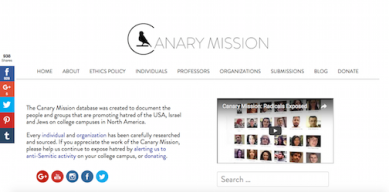
Against Canary Mission: Statement Condemning the Blacklisting of pro-BDS Student Activists

A milestone in the global BDS and Palestine solidarity movement was achieved in the last screen-shot-2016-10-05-at-8-58-33-amweek of September 2016 when more than 1,000 University faculty across the world signed a published petition condemning the Islamophobic, racist and sexist website Canary Mission: http://againstcanarymission.org

As reported previously on the MLAboycott website in August, Canary Mission is an anonymous on-line website dedicated to smearing, blacklisting and harassing Palestine solidarity activists. Continue reading

Rosaura Sánchez’s Statement in Support of a Boycott of Israeli Academic Institutions

Rosaura Sánchez is a Professor in the Literature Department at the University of California, San images-1-copyDiego.  She is the author of articles, books and essays dealing with Chicano/a – Latino/a literatures and criticism and theory and a creative writer, author of short stories and co-author of the sci-fi novel Lunar Braceros.  She is a former member of the MLA Executive Committee and a current member of the MLA Delegate Assembly.

Sign the “Open Letter” calling on the MLA membership to endorse a resolution in support of the boycott of Israeli academic institutions. Only the signatures of (former or current) MLA members will be included.

I would like to urge all MLA members to heed the call to support the academic boycott of Israeli institutions in view of Israel’s occupation of Palestinian territory and apartheid policies in historic Palestine.  For someone who has long studied the history of U.S. dispossession of the indigenous and Mexican populations in the Southwest, the parallels are all too clear. I am indignant that today’s world tolerates the dispossession and segregation of the Palestinian people and I am especially incensed at my own government for contributing close to three billion dollars a year of our tax dollars to the Israeli state, much of it in military aid to attack, oppress, and subjugate the Palestinian people in Gaza and the West Bank.

It is necessary that Israeli academicians and the Israeli populace rise up in protest of their state’s settler colonialism and stop the establishment of new settlements on the West Bank.  It is crucial that the change in Israeli policies come from within, with Israeli citizen protests and demands to dismantle their state’s apartheid policies and end their unconscionable policies of discrimination, intolerance and rights denial of Palestinians and the blockade of Gaza.  It is time to tear down the wall that separates Palestinians from their land.  The complicity of Israeli academic institutions in these policies, in the denial of education rights of Palestinian students in Gaza, and in the bombing of schools and universities is what leads us to propose the boycott of Israeli academic institutions.  It is not about Jews versus non-Jews; it is about Palestinian dispossession and Israeli violence.  We academics in the U.S. must also place pressure on our own government and on corporations to stop military aid and financial and political support to the Israeli state.  The BDS movement is our opportunity as academics to make our outrage known.   The MLA academic boycott of Israeli institutions will speak loud and clear about our dissent with current Israeli policies of aggression against Palestinians and U.S. collusion with these practices.


Pranav Jani’s Statement in Support of a Boycott of Israeli Academic Institutions

Pranav Jani is Associate Professor of English at The Ohio State University, working in postcolonial studies and US ethnic studies.  Pranav’s book, Decentering Rushdie, examined cosmopolitanism janiand nationalism in Indian English fiction; he’s currently researching the changing legacies of the Revolt of 1857 in the Indian political imagination.  Jani has published scholarly work on Marxism, historiography, nationalism, postcolonial theory and Subaltern Studies, Indian and diasporic fiction and film, and Indian revolutionaries.  His lectures and articles for activist forums can be found at wearemany.org, Socialist Worker, and International Socialist Review.  Pranav is a long-time member of the International Socialist Organization, and is involved in efforts in Columbus around Palestine solidarity, the Black Lives Matter movement, and academic freedom.

Sign the “Open Letter” calling on the MLA membership to endorse a resolution in support of the boycott of Israeli academic institutions. Only the signatures of (former or current) MLA members will be included.

“What, then, remains to be argued?”

In his famous 1852 speech, “What to the Slave is the Fourth of July?,” Frederick Douglass expertly uses rhetorical strategies to establish to his white, liberal audience that (1) abolition of slavery is a position supported by reason, and ought to be the position of anyone valuing democracy, but also that (2) when all the arguments have been made, and all the logic of this or that position has been debated, there is nothing left to do but to present the horrors of slavery once more, to point directly to the hypocrisy of a “democratic” country that suppresses liberty, and to conclude that disagreement in this matter is ultimately not just about debate or reason but about deeply-held political positions.

Once it is established that the slave is a human being and that human beings deserve liberty, Douglass argues, what is left to say but that slavery must be abolished?  I’m sure you’ve come across these lines, or taught them in class:

At a time like this, scorching irony, not convincing argument, is needed. O! Had I the ability, and could I reach the nation’s ear, I would, to-day, pour out a fiery stream of biting ridicule, blasting reproach, withering sarcasm, and stern rebuke. For it is not light that is needed, but fire; it is not the gentle shower, but thunder. We need the storm, the whirlwind, and the earthquake. The feeling of the nation must be quickened; the conscience of the nation must be roused; the propriety of the nation must be startled; the hypocrisy of the nation must be exposed; and its crimes against God and man must be proclaimed and denounced.

And so it is with Palestine. Continue reading

Palestine, Settler Colonialism and Democratic Education at UC Berkeley

The University of California has a long tradition of high-ranking administrators on the 14066283_10157447923250515_1892003510723741784_owrong side of history. Clark Kerr’s name lives on in memory for most only as that “able practitioner of managerial tyranny” denounced by Mario Savio in December 1964 in the heat of the Free Speech Movement. This week UC Berkeley’s Chancellor, Nicholas Dirks and Carla Hesse, Executive Dean of Science and Letters, proved once again that Berkeley administrators have yet to learn the lessons of the civil rights movement, though in the intervening 50 years generations of students have flocked to the campus and enriched it financially, intellectually and ethically precisely because of its legacy as a place of social transformation and free intellectual and political exchange.

On Tuesday September 13, Dean Hesse suspended a student-run “Democratic Education at Cal” or “DeCal” course titled “Palestine: A Settler Colonial Analysis” (Ethnic Studies 98/198), which had been approved through the normal, scrupulous vetting process of the Academic Senate. On that day, The Office of the Chancellor, having received a letter of complaint about the course sent by outside pressure groups at 7:35 am, had by 10:26 am replied to the spokesperson for the Zionist campus watch group, AMCHA, announcing the suspension. This is to say that a decision to abrogate the authority of the Academic Senate and to violate the right to education of UC Berkeley students was made in less than three hours by two administrators after receipt of the AMCHA complaint. Continue reading